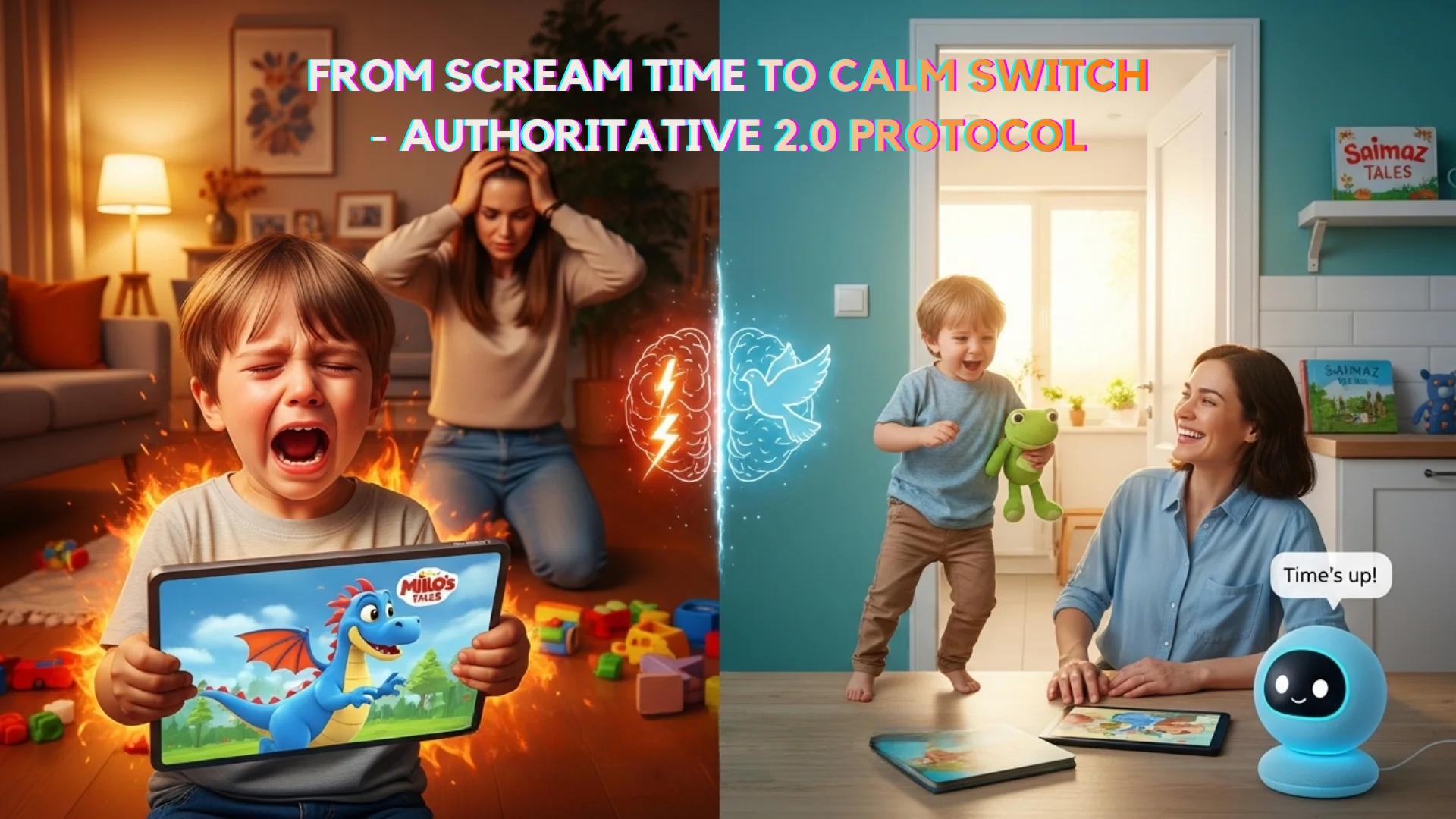
We’ve all been there: the dreaded reach for the remote, the “one more minute” plea, and then—the inevitable explosion. In the parenting world of 2026, we’ve learned that these “Screen Time Meltdowns” aren’t just a test of your patience; they are a predictable biological reaction to a toddler dopamine crash. If you’ve found that standard “Gentle Parenting” techniques are leaving you exhausted and your child dysregulated, it’s time for an upgrade. Welcome to Authoritative 2.0.
In this guide, we’re moving beyond the 20-minute negotiations and moving toward the Saimaz Switch-Over Protocol—a neuro-affirming, science-backed strategy designed to bridge the gap between the digital world and the real one. By understanding the neural handover between the amygdala and the prefrontal cortex, you can finally stop screen time tantrums and reclaim your evenings. It’s time to stop being the “villain” of the living room and start leading your family with the “Lighthouse” confidence of a secure, regulated leader.
Why does my child scream when I turn off the TV?
Quick Answer: Your child is likely experiencing a “dopamine crash.” When high-stimulation content ends abruptly, the brain’s alarm system (the amygdala) takes over, causing a biological fight-or-flight response known as a transition tantrum.
The Biology of the “Screan Time” Meltdown
To understand why a sweet toddler suddenly turns into a whirlwind of fury the moment the iPad goes dark, we have to look at the neurochemistry of 2026 digital consumption. When children watch high-energy, fast-paced shows, their brains are flooded with dopamine—the “feel-good” neurotransmitter.
The moment the screen is toggled off, that dopamine supply doesn’t just dip; it vanishes. This creates a physiological void. Because a toddler’s prefrontal cortex (the logic center) is still “under construction,” they cannot rationally process this sudden drop. Instead, the amygdala—the brain’s emotional panic button—screams “danger!”
Understanding the Neural Handover
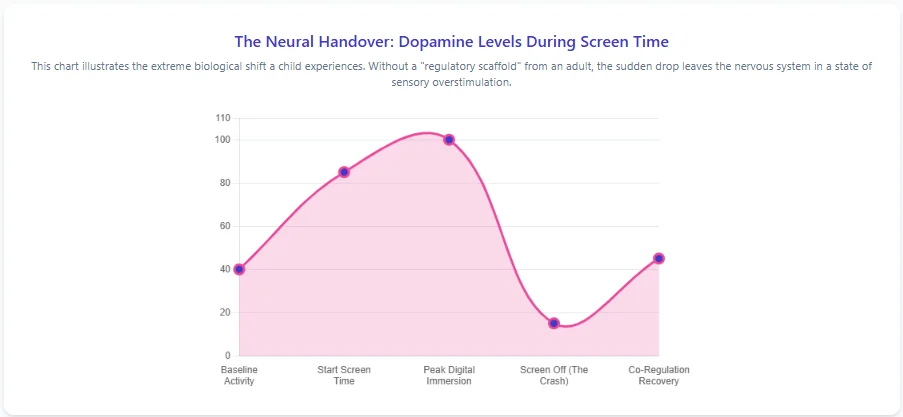
In the Saimaz Protocol, we call this the Neural Handover failure. Normally, the brain should smoothly transition from a high-stimulus state to a resting state. However, digital immersion is so intense that the “handover” fumbles.
As seen in the chart above, the “Peak Digital Immersion” creates a massive spike. When the “Screen Off” event occurs, the resulting “Crash” leaves the nervous system in a state of sensory overstimulation. Without a “Regulatory Scaffold”—a strategy provided by the parent—the child is biologically incapable of staying calm.
They aren’t being “naughty” or “defiant”; they are experiencing a temporary neurological crisis. Recognizing this shift from behavioral to biological is the first step in the Authoritative 2.0 journey.
Gentle Parenting vs. Authoritative 2.0 for Screen Time
Quick Answer: While Gentle Parenting focuses on avoiding conflict and validating feelings, Authoritative 2.0 balances that empathy with firm, non-negotiable boundaries. In 2026, this “Secure Leader” approach is the gold standard for screen-time because it stops the cycle of endless negotiations and replaces them with predictable, kind authority that helps a child feel safe.
Why “Gentle Parenting” Often Fails at the Screen
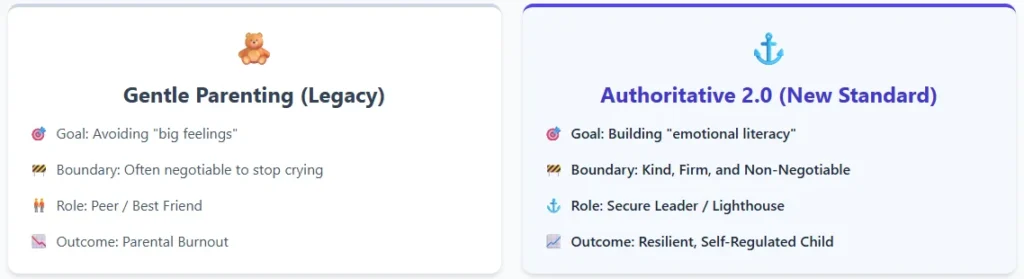
Many parents have found themselves trapped in a loop of “gentle” negotiations: “Just five more minutes, honey?” or “Please, let’s turn it off now.” While these methods prioritize the child’s feelings, they often lack the structural “anchor” a toddler needs during a dopamine crash. In the digital age, being a “Peer” or “Best Friend” can lead to Parental Burnout, as the child is left to make decisions their developing brain simply isn’t ready for.
The Authoritative 2.0 Shift: Being the Lighthouse
In 2026, we are moving toward Authoritative 2.0. This isn’t about returning to the harsh, “because I said so” authoritarianism of the past. Instead, it’s about becoming a Lighthouse Leader.
As shown in the comparison above, the primary shift is in the Boundary. In the Authoritative 2.0 framework:
- The Goal moves from merely avoiding “big feelings” to building emotional literacy.
- The Role shifts from a peer to a Secure Leader.
- The Outcome is a resilient, self-regulated child who knows that while their feelings are always valid, the boundary is kind, firm, and non-negotiable.
By setting a clear, external standard, you actually reduce your child’s anxiety. They no longer have to wonder if they can negotiate for more time; the “Lighthouse” remains steady, allowing them to focus on the work of regulation rather than the work of persuasion.
How to end screen time meltdowns without yelling
Quick Answer: To end meltdowns without raising your voice, you must move from being the “villain” to the “ally” by using the Saimaz Switch-Over Protocol. This involves using visual anchors, naming the emotion to “tame” the amygdala, and offering a high-energy physical “pivot” (like hopping or stomping) to help the child process the sudden drop in dopamine.
The Saimaz Switch-Over Protocol: Your 3-Step Strategy
Yelling usually happens when we feel powerless against a child’s screaming. The Saimaz Protocol restores your power by shifting the focus from “compliance” to “regulation.” Instead of fighting the tantrum, you are guiding your child through a biological transition.
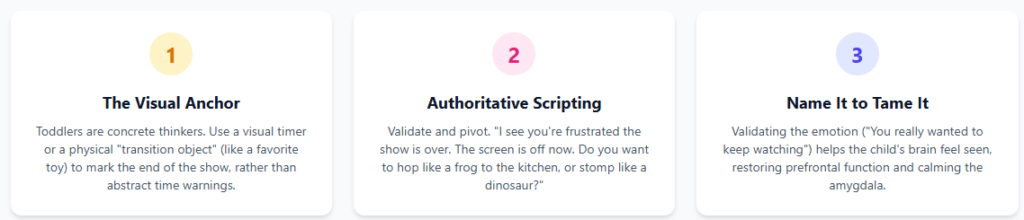
1. The Visual Anchor (Prep the Brain)
Toddlers are concrete thinkers. Verbal warnings like “five minutes left” often disappear into the digital fog. Use a Visual Anchor—a physical timer or an AI-guided countdown. When the “Visual Anchor” signals the end, it is the tool setting the boundary, not your mood. This allows you to stay in the role of the supportive ally.
2. Authoritative Scripting (The Kind, Firm Pivot)
In the Authoritative 2.0 framework, we replace “pleading” with “scripting.” Instead of asking, “Are you ready to turn it off?” use a Kind & Firm Pivot: “The timer is finished. It’s time to move our bodies! Are we going to hop like frogs or stomp like dinosaurs to the snack table?” By giving a choice between two physical actions, you bypass the “No” and engage the brain’s motor cortex.
3. Name It to Tame It (The Amygdala Cool-Down)
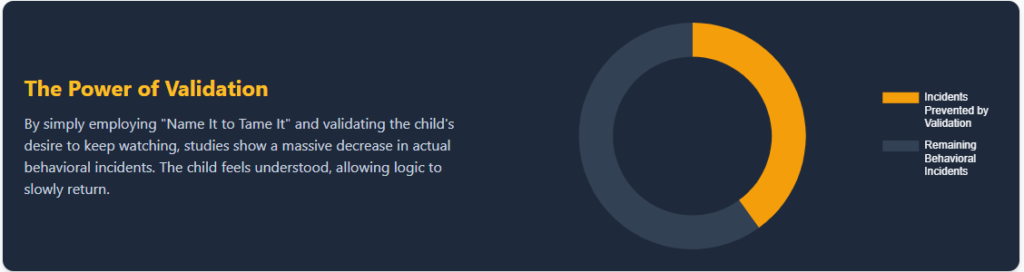
If the meltdown starts, don’t meet their fire with your own. Use the Name It to Tame It technique. Acknowledge the dopamine crash: “I see you are so sad that the show is over. It’s hard to stop when we’re having fun.” Naming the emotion sends a signal to the amygdala that it is safe, allowing the prefrontal cortex to come back online. As shown in our validation data, this simple act of empathy can reduce the intensity of a behavioral incident by nearly half.
Why the “Physical Pivot” Works
When a child is stuck in a “Digital Loop,” their body is stationary but their brain is racing. A high-energy physical movement—like a “frog hop”—forces the brain to switch gears from passive consumption to active movement. This “Analog Pivot” is the fastest way to help a nervous system recover from a dopamine drop without the need for a power struggle.
Using AI timers for toddler transitions
Quick Answer: Using a “neutral third party” like an AI voice assistant (Alexa or Google Home) removes the power struggle between parent and child. When the AI announces “Time is up,” the parent can remain a supportive co-regulator who helps the child follow the external rule, rather than being the source of the frustration.
Radical Delegation: Making Technology the “Bad Guy”
One of the most exhausting parts of parenting in 2026 is the constant role-switching. One minute you are the fun playmate, and the next, you are the “Screen-Time Police.” This flip-flopping often triggers defiance because the child views you as the person stealing their dopamine.
By implementing Radical Delegation, you shift the role of the “boundary setter” to a neutral device. When a neutral AI voice or a visual robot timer handles the countdown, the “No” becomes an objective fact of the environment—much like the sun setting—rather than a subjective whim of a parent.
From “Villain” to “Ally”
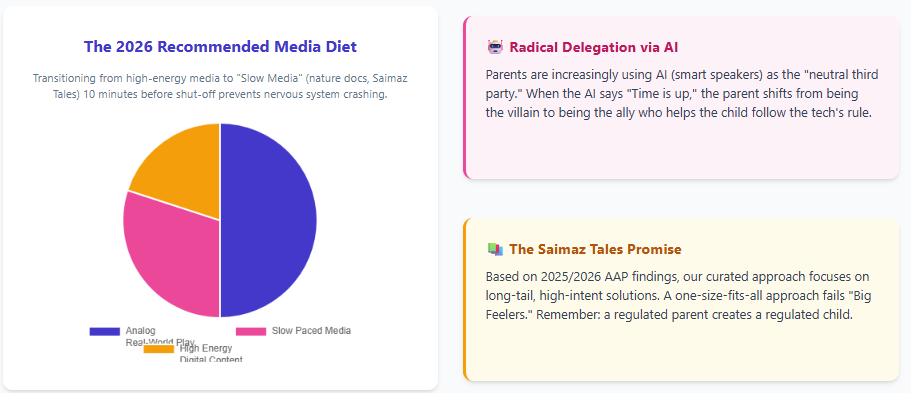
As illustrated in our 2026 Media Diet chart, the key to a successful household rhythm is maintaining your role as the Lighthouse Leader. When the AI timer goes off:
- Acknowledge the Device: “Oh! The robot says it’s time to stop. He’s keeping us on track for our snack time!”
- Join the Child: Instead of standing over them, get on their level. “The robot is pretty firm about that schedule, isn’t he? It’s hard to stop. Do you want a hug while we walk to the kitchen?”
- Co-Regulate: Because you didn’t “break” the fun, your child is more likely to accept your comfort. You are now two people together, following a shared rule.
Why this works for Authoritative 2.0
This isn’t about passing the buck; it’s about strategic boundary management. In the Authoritative 2.0 framework, we recognize that our primary job is to help our children regulate. By delegating the “enforcer” role to technology, we preserve the parent-child bond. This ensures that even when the dopamine crashes, the connection remains intact, allowing for a faster emotional recovery.
Conclusion: The Future of Digital Parenting is Authoritative
As we navigate the complexities of raising children in 2026, it’s clear that the old “all-or-nothing” approach to technology no longer serves us. The secret to ending the cycle of screen-time meltdowns isn’t a faster timer or a louder voice; it is the Saimaz Switch-Over Protocol—a bridge built on neuro-biology and steady leadership.
By moving toward Authoritative 2.0, you are doing more than just turning off a tablet. You are teaching your child how to navigate a dopamine crash, how to regulate their nervous system, and how to trust in your kind, firm guidance.
Key Takeaways for a Tantrum-Free 2026:
- Respect the Biology: Remember that transition meltdowns are a “dopamine crash,” not a character flaw. Your child needs a regulatory scaffold, not a lecture.
- Pivot, Don’t Push: Use Visual Anchors and high-energy physical movements (like the “frog hop”) to help the brain transition from the digital world to the analog one.
- Radical Delegation: Stop being the “villain.” Let a neutral third party, like an AI assistant, set the boundary so you can remain the supportive ally.
- Curate the Diet: Focus on “Slow Media” and analog play to keep the nervous system balanced.
Ultimately, a regulated parent creates a regulated child. As you implement these tools, remember the Saimaz Tales Promise: we are here to provide the long-tail, high-intent solutions that help “Big Feelers” and their families thrive in a digital age.
Ready to start your first Saimaz Reset? Choose your child’s favorite “Analog Pivot” toy today and watch the transformation happen.